How to Calculate Range in Math
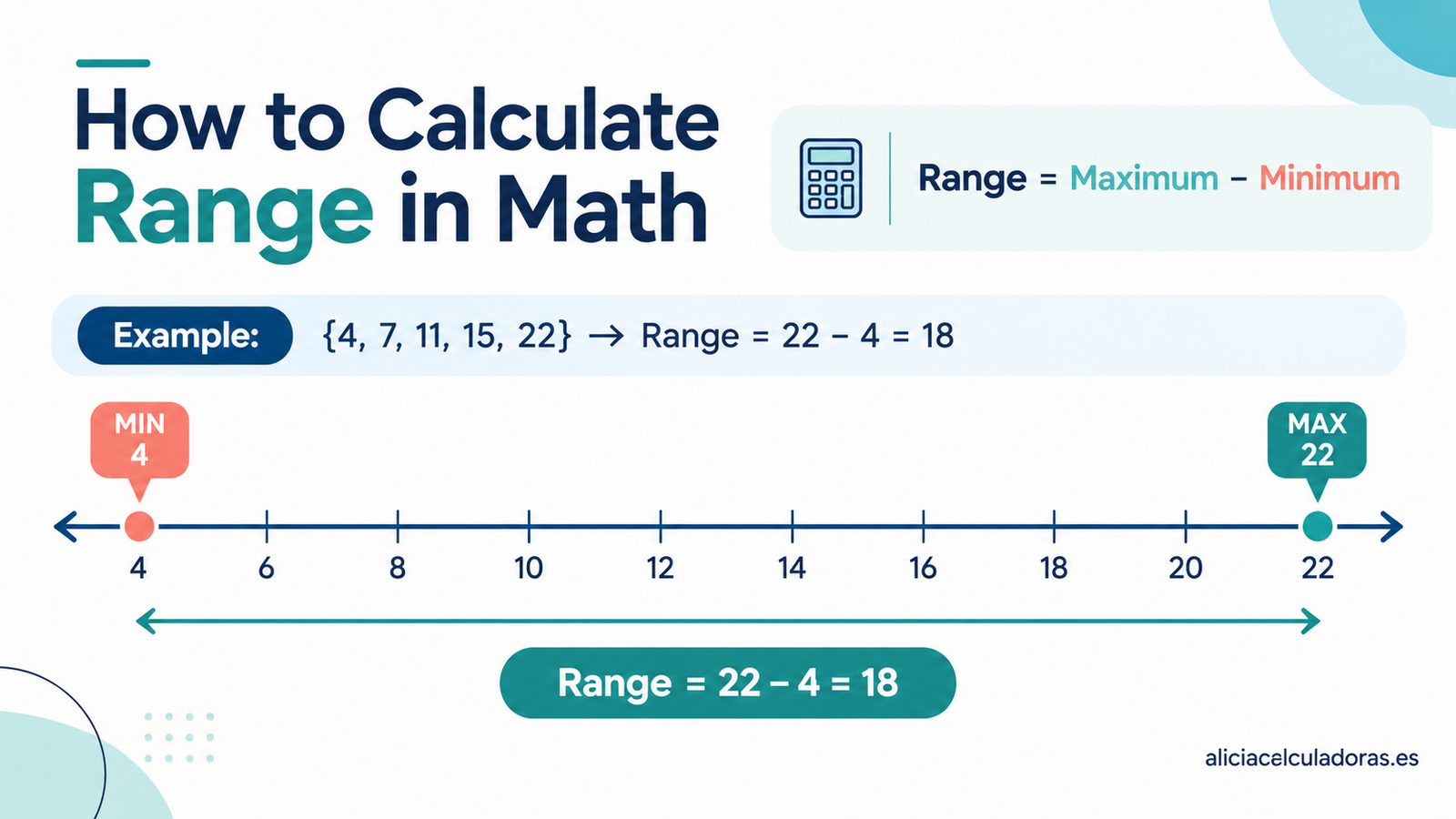
The range in math is the difference between the highest and lowest values in a set of data.
In simple words, range tells you how far apart the smallest and largest values are.
For example, consider these numbers:
4, 7, 9, 12, 15
The highest value is 15 and the lowest value is 4.
So:
Range = 15 − 4 = 11
Therefore, the range is 11.
Range is commonly used when working with data sets, statistics, measurements, scores, temperatures, prices, and other numerical information.
What Is the Range Formula?
The basic formula for finding range is:
Range = Maximum Value − Minimum Value
Here:
- Maximum value = highest number in the data set
- Minimum value = lowest number in the data set
For example:
8, 3, 12, 5, 10
Maximum value = 12
Minimum value = 3
Therefore:
Range = 12 − 3
Range = 9
So, the range of the data set is 9.
How to Calculate Range in Math
Finding the range is usually a simple three-step process. You do not always need to arrange the numbers first, although sorting them can make the maximum and minimum easier to identify.
Step 1: Find the Highest Value
Look through the data set and identify the largest number.
Step 2: Find the Lowest Value
Find the smallest number in the data set.
Step 3: Subtract the Lowest Value From the Highest
Use the range formula:
Range = Highest Value − Lowest Value
Example
Find the range of:
18, 7, 25, 11, 14
Highest value = 25
Lowest value = 7
Now subtract:
25 − 7 = 18
Range = 18
Examples of Finding the Range
Example 1: Range of a Simple Data Set
Find the range of:
6, 10, 3, 15, 8
First, identify the largest and smallest values.
- Highest =
15 - Lowest =
3
Now calculate:
15 − 3 = 12
Answer: 12
Example 2: Range of an Unordered List
The numbers do not need to be written from smallest to largest.
Find the range of:
42, 18, 35, 9, 27, 51
The highest number is:
51
The lowest number is:
9
Therefore:
Range = 51 − 9
Range = 42
Answer: 42
You can arrange the numbers first if that makes the calculation easier:
9, 18, 27, 35, 42, 51
The first number is the minimum and the last number is the maximum.
Example 3: Range With Negative Numbers
Range can also be calculated when a data set contains negative numbers.
Consider:
-8, -3, 4, 7, -12
The highest value is 7.
The lowest value is −12.
Now subtract:
7 − (-12)
When subtracting a negative number, the calculation becomes:
7 + 12 = 19
Therefore:
Range = 19
The important thing is to identify the actual highest and lowest values before performing the subtraction.
Example 4: Range With Decimals
The same formula works with decimal numbers.
Find the range of:
2.5, 4.8, 1.7, 6.2, 3.4
Highest value = 6.2
Lowest value = 1.7
Now subtract:
6.2 − 1.7 = 4.5
Range = 4.5
Example 5: Range When All Values Are the Same
What happens if every number in a data set is identical?
Consider:
12, 12, 12, 12
The maximum value is 12.
The minimum value is also 12.
Therefore:
12 − 12 = 0
Range = 0
A range of zero means there is no difference between the smallest and largest values.
How to Find a Missing Value Using the Range
The range formula can also be rearranged when the range and one extreme value are known.
Remember:
Range = Highest Value − Lowest Value
Finding the Highest Value
Suppose:
- Range =
15 - Lowest value =
20
We need to find the highest value.
Start with:
15 = Highest Value − 20
Add 20 to both sides:
Highest Value = 15 + 20
Highest Value = 35
Answer: 35
Finding the Lowest Value
Suppose:
- Range =
18 - Highest value =
50
Use:
18 = 50 − Lowest Value
Rearrange:
Lowest Value = 50 − 18
Lowest Value = 32
Answer: 32
This method is useful when a question gives you the range and asks you to find a missing maximum or minimum value.
Range With a Frequency Table
Range can also be found when data is presented in a frequency table.
A frequency table shows values or groups of values along with how often they occur.
For example:
| Class Interval | Frequency |
|---|---|
| 10–20 | 3 |
| 20–30 | 5 |
| 30–40 | 8 |
| 40–50 | 4 |
For grouped data, the range can be determined using the boundaries of the lowest and highest class intervals.
Here:
- Lowest class boundary =
10 - Highest class boundary =
50
So:
Range = 50 − 10
Range = 40
The exact method can depend on how the grouped data is presented, so it is important to follow the convention used in your statistics course.
Range vs. Mean, Median, and Mode
Range, mean, median, and mode are commonly studied together, but they describe data in different ways.
| Measure | What it tells you |
|---|---|
| Mean | The average of the values |
| Median | The middle value when data is arranged in order |
| Mode | The value that occurs most often |
| Range | The difference between the highest and lowest values |
For example, consider:
2, 4, 4, 6, 9
Mean
Add all the values and divide by the number of values:
(2 + 4 + 4 + 6 + 9) ÷ 5 = 5
Mean = 5
Median
The middle value is:
4
Median = 4
Mode
The number that occurs most often is:
4
Mode = 4
Range
Highest = 9
Lowest = 2
9 − 2 = 7
Range = 7
So each measure gives us different information about the same data set.
How Outliers Affect the Range
An outlier is a value that is unusually far from the other values in a data set.
Because the range only depends on the highest and lowest values, an extreme value can change the range significantly.
Consider:
10, 12, 13, 14, 15
Range:
15 − 10 = 5
Now suppose a much larger value is added:
10, 12, 13, 14, 15, 50
The new range is:
50 − 10 = 40
The range increased from 5 to 40 because the new value became the maximum.
This is one reason why range should be considered alongside other measures when describing a data set.
Common Mistakes When Calculating Range
Although the formula is simple, a few mistakes are common.
1. Using the Wrong Maximum or Minimum
Do not assume that the first or last number in a list is the highest or lowest.
For example:
7, 21, 4, 15, 9
The maximum is 21, not 15.
The minimum is 4.
2. Subtracting in the Wrong Direction
The formula is:
Highest − Lowest
Not:
Lowest − Highest
For example:
18 − 5 = 13
The range is 13, not −13.
3. Forgetting Negative Numbers
Be especially careful when the minimum value is negative.
For:
-6, 2, 8
the range is:
8 − (-6) = 14
4. Confusing Range With the List of Values
The range is one numerical difference, not the interval written from the minimum to maximum.
For:
2, 5, 8
the range is:
8 − 2 = 6
So the answer is 6, not “2 to 8.”
5. Confusing Range With Mean, Median, or Mode
These are different statistical measures. Always check what the question is asking before calculating.
How to Calculate Range Quickly
For a short list of numbers, you can calculate the range mentally.
For example:
11, 5, 18, 7, 13
Look for the two extremes:
- Maximum =
18 - Minimum =
5
Then:
18 − 5 = 13
Range = 13
You do not need to calculate the mean, median, or mode when the question only asks for the range.
For a large data set, a range calculator can help you identify the minimum and maximum values and calculate their difference quickly.
Practice Questions
Try these questions yourself before checking the answers.
Question 1
Find the range:
4, 9, 15, 2, 11
Question 2
Find the range:
-5, 3, 8, -2, 10
Question 3
Find the range:
2.4, 5.8, 1.2, 7.6
Question 4
The range of a data set is 12. The lowest value is 18. What is the highest value?
Question 5
The range is 20 and the highest value is 45. What is the lowest value?
Answers
1. 15 − 2 = 13 → 13
2. 10 − (-5) = 15 → 15
3. 7.6 − 1.2 = 6.4 → 6.4
4. 12 + 18 = 30 → 30
5. 45 − 20 = 25 → 25
Frequently Asked Questions
What is the range in math?
The range is the difference between the highest and lowest values in a data set.
Range = Maximum − Minimum
How do you calculate range in math?
Find the highest value, find the lowest value, and subtract the lowest value from the highest value.
Can the range be zero?
Yes. If the highest and lowest values are the same, the range is zero.
For example:
5, 5, 5, 5
5 − 5 = 0
Can the range be negative?
No. When the range is calculated correctly, it is zero or a positive number because the highest value is always greater than or equal to the lowest value.
Do I need to arrange the numbers before finding the range?
No. You can identify the highest and lowest values without arranging the data. However, putting the numbers in ascending order can make them easier to identify.
How do you find the range with negative numbers?
Find the highest and lowest values as usual, then subtract:
Highest − Lowest
For example:
-10, -3, 4
4 − (-10) = 14
So the range is 14.
How does an outlier affect the range?
An extreme value can make the range much larger because the range depends only on the highest and lowest values.
Key Takeaway
Learning how to calculate range in math is simple once you remember one formula:
Range = Highest Value − Lowest Value
To calculate it:
- Find the highest value.
- Find the lowest value.
- Subtract the lowest value from the highest.
- Check your calculation, especially when negative numbers or decimals are involved.
Range is useful for understanding the spread between the smallest and largest values in a data set. Once you understand the basic formula, you can also use it to solve questions involving missing values, frequency tables, and real-world data.