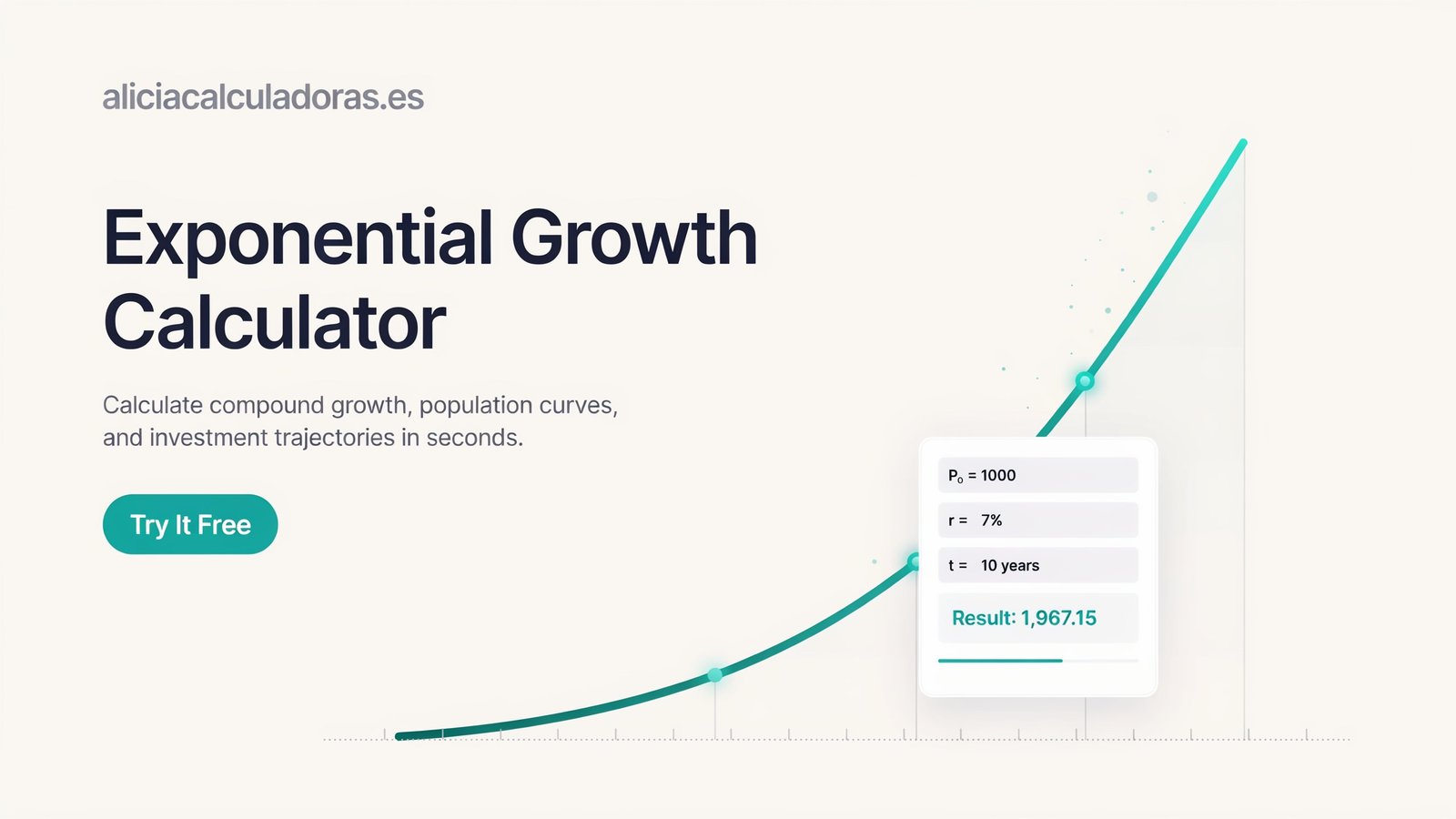
Exponential Growth Calculator
An exponential growth calculator calculates the future value of a quantity that increases by a constant percentage over equal periods.
The standard formula for discrete exponential growth is:
Where:
- x(t) = final value after time
t - x₀ = initial value
- r = growth rate as a percentage
- t = number of time periods
For example, if a quantity starts at 2,500 and grows by 6% per year for 4 years:
So, the projected final value is 3,156.19.
The important difference between exponential and linear growth is that exponential growth applies the percentage to the current value, so the amount added can become larger with every period.
What Is Exponential Growth?
Exponential growth happens when a quantity increases by a constant percentage or proportional rate over repeated periods.
The percentage stays the same, but the actual amount of growth changes because each increase is based on the current value.
For example, start with 1,000 and assume 10% growth per year:
| Year | Value |
|---|---|
| 0 | 1,000 |
| 1 | 1,100 |
| 2 | 1,210 |
| 3 | 1,331 |
| 4 | 1,464.10 |
| 5 | 1,610.51 |
The increase is:
- Year 1: +100
- Year 2: +110
- Year 3: +121
- Year 4: +133.10
Although the growth rate remains 10%, the amount added becomes larger.
That is the basic idea behind an exponential growth model.
Exponential Growth Formula
The standard discrete exponential growth equation is:
This formula is used when a quantity changes by a fixed percentage during each period.
What Do the Variables Mean?
| Symbol | Meaning |
|---|---|
| x(t) | Final value |
| x₀ | Initial value |
| r | Growth rate in percent |
| t | Number of periods |
| 1 + r/100 | Growth factor |
For example, a growth rate of 8% becomes:
Therefore:
The equation becomes:
Growth Rate vs. Growth Factor
These terms are related but different.
For a 6% growth rate:
- Decimal growth rate = 0.06
- Growth factor = 1.06
The growth factor is the number raised to the power of t.
How to Calculate Exponential Growth
To calculate exponential growth manually:
Step 1: Identify the initial value
Suppose:
Step 2: Find the growth rate
Suppose the rate is:
Step 3: Determine the number of periods
If the growth continues for 5 years:
Step 4: Substitute the values
Step 5: Calculate
Therefore, the projected value after 5 years is 2,524.59.
Exponential Growth Example
Suppose a website has 8,000 monthly users and its audience grows by 12% per month.
What would the model predict after 6 months?
Given:
- Initial value = 8,000
- Growth rate = 12%
- Time = 6 months
Use:
Substitute the values:
So the projected value is approximately 15,791 users after 6 months.
This is a mathematical projection based on the assumption that the 12% monthly growth rate remains constant.
How to Use an Exponential Growth Calculator
An exponential growth calculator saves time when you do not want to calculate powers manually.
For the calculator on this page, enter the required values:
1. Enter the initial value
Enter the starting amount.
For example:
2,000
2. Enter the growth rate
Enter the percentage increase.
For example:
5%
3. Enter the elapsed time
Enter the number of periods.
For example:
10
4. Select the time unit
Choose the unit that matches the growth rate, such as:
- Seconds
- Minutes
- Hours
- Days
- Weeks
- Months
- Years
5. Calculate the final value
The calculator applies the exponential growth formula and gives the projected value.
Keep the Rate and Time Units Consistent
This is one of the most important parts of an exponential growth calculation.
If the rate is 5% per year, use time in years.
If the rate is 5% per month, use time in months.
For example, 5% monthly growth for 12 months means:
You should not enter 1 just because 12 months equals one year.
How to Calculate the Exponential Growth Rate
Sometimes you know the starting value, final value, and elapsed time but need to find the growth rate.
Starting with:
Rearrange the equation:
Example
Suppose a quantity increases from 1,500 to 1,996.50 in 4 years.
The result is approximately:
So the constant annual exponential growth rate is approximately 7.4%.
This calculation is useful when historical data gives you the beginning and ending values but not the rate.
How to Calculate the Time Needed to Reach a Value
You can also calculate how long it takes a quantity to reach a target value.
Use:
Example
Suppose:
- Initial value = 1,000
- Target value = 1,500
- Growth rate = 8% per period
Then:
Therefore, it takes approximately 5.27 periods to reach 1,500 under this constant-growth model.
The natural logarithm is needed because the unknown time is in the exponent.
How to Calculate the Initial Value
If the final value, growth rate, and time are known, you can work backward to find the starting value.
The formula is:
Example
Suppose:
- Final value = 5,000
- Growth rate = 6%
- Time = 5 periods
Then:
So the estimated initial value is approximately 3,736.29.
Exponential Growth vs. Linear Growth
Exponential growth and linear growth are not the same.
| Feature | Exponential Growth | Linear Growth |
|---|---|---|
| Main idea | Percentage-based increase | Fixed increase |
| Formula | ||
| Amount added | Changes | Constant |
| Graph | Curves upward for positive growth | Straight line |
| Long-term behavior | Can accelerate rapidly | Changes at a constant rate |
For example, start with 1,000.
With linear growth of 100 per period:
1,000 → 1,100 → 1,200 → 1,300
With exponential growth of 10%:
1,000 → 1,100 → 1,210 → 1,331
Both increase by 100 during the first period, but after that their results become different.
Discrete vs. Continuous Exponential Growth
There are two common ways to represent exponential growth.
Discrete Exponential Growth
When a percentage is applied during separate periods, use:
This is the model used for repeated percentage increases such as annual or monthly growth.
Continuous Exponential Growth
For continuous growth, a common equation is:
Where:
- x₀ = initial value
- e ≈ 2.71828
- k = continuous growth constant
- t = time
These formulas are related, but the rate parameter is defined differently. You should not put a discrete percentage rate directly into the continuous formula without converting it appropriately.
How Different Growth Rates Change the Result
Even a small difference in the growth rate can produce a substantial difference over many periods.
Starting with 100 and applying each rate for 10 periods:
| Growth Rate | Value After 10 Periods |
|---|---|
| 1% | 110.46 |
| 3% | 134.39 |
| 5% | 162.89 |
| 8% | 215.89 |
| 10% | 259.37 |
The initial value and number of periods remain the same. Only the growth rate changes.
This is why an exponential increase calculator can be useful for comparing different growth assumptions.
Doubling Time in Exponential Growth
Doubling time is the number of periods required for a quantity to become twice its initial value.
For a discrete growth rate:
For example, at an 8% growth rate:
So the quantity would take approximately 9.01 periods to double, assuming the 8% rate remains constant.
Exponential Growth in Real-World Models
Exponential growth can be used as a simplified model in several areas, including:
- Population studies
- Bacterial or biological growth
- Compound growth
- Business and customer growth
- Website traffic or subscriber growth
- Technology adoption
- Some financial models
The model is most appropriate when a percentage-based rate is a reasonable approximation for the period being studied.
However, real-world growth usually does not continue at exactly the same rate indefinitely.
Limitations of Exponential Growth
An exponential growth calculation gives a projection based on an assumption. It does not guarantee that the real quantity will follow the same path.
A constant growth rate may become unrealistic because of:
- Limited resources
- Market saturation
- Competition
- Changes in demand
- Environmental factors
- Economic conditions
- Population limits
For example, a business that grows 10% every month cannot automatically be expected to maintain that rate forever.
For some population models, a logistic growth model may be more appropriate because it can account for a limiting or carrying capacity.
Common Exponential Growth Mistakes
1. Entering the percentage incorrectly
A 5% rate is:
Therefore:
Do not confuse 5% with the decimal 5 when calculating manually.
2. Confusing growth rate with growth factor
For 8% growth:
- Rate = 8%
- Decimal rate = 0.08
- Growth factor = 1.08
3. Forgetting the exponent
The number of periods must be used as the exponent:
4. Mixing time units
A monthly growth rate requires time in months unless the rate is first converted to another time basis.
5. Rounding too early
Keep extra decimal places during intermediate calculations and round the final answer.
6. Assuming the model is always realistic
A constant exponential rate is an assumption. Real-world data may speed up, slow down, or fluctuate.
Exponential Growth Calculator: Worked Example
Suppose a quantity starts at 750 and increases by 4% every hour. Find its value after 12 hours.
Enter:
- Initial value: 750
- Growth rate: 4%
- Time: 12
- Time unit: hours
Formula:
Therefore, the projected final value is 1,200.77.
Notice that the rate is per hour, so the elapsed time is also entered in hours.
When Should You Use an Exponential Growth Calculator?
An exponential growth calculator is useful when you need to calculate or compare percentage-based growth without manually evaluating powers and logarithms.
It can help with:
- Population projections
- Business growth estimates
- Compound growth
- Website or subscriber growth
- Repeated percentage increases
- Mathematical homework
- Scientific models
- Comparing different growth rates
- Finding a target time
- Estimating a starting value
If you already know the initial value, growth rate, and number of periods, the calculator can quickly determine the projected final value.
Frequently Asked Questions
What is an exponential growth calculator?
An exponential growth calculator is an online tool that calculates how a quantity changes when it grows by a constant percentage over repeated periods.
What is the exponential growth formula?
The standard discrete formula is:
Where x₀ is the initial value, r is the percentage growth rate, and t is the number of periods.
How do I calculate exponential growth?
Identify the initial value, convert the percentage rate to decimal form, add it to 1, raise the result to the number of periods, and multiply by the initial value.
What is a growth factor?
A growth factor is the multiplier applied during each period. For example, a 5% growth rate has a growth factor of 1.05.
How do I calculate the exponential growth rate?
If the initial value, final value, and time are known:
How do I calculate the time required for exponential growth?
Use:
This formula is useful when the target value and growth rate are known.
What is the difference between exponential and linear growth?
Linear growth adds the same amount during each period. Exponential growth applies a percentage to the current value, so the amount added changes over time.
Can exponential growth have a negative rate?
A negative rate represents a decrease rather than growth and is generally described as exponential decay.
Can exponential growth continue forever?
The mathematical formula can be extended indefinitely, but a constant growth rate may not remain realistic in the real world.
Final Takeaway
Exponential growth describes a quantity that changes by a constant percentage over repeated periods.
The main formula is:
For accurate results, make sure you have the correct:
- Initial value
- Growth rate
- Number of periods
- Matching time units
For more complex calculations involving powers, logarithms, growth rates, or target times, an exponential growth calculator can perform the calculation quickly while reducing manual errors.