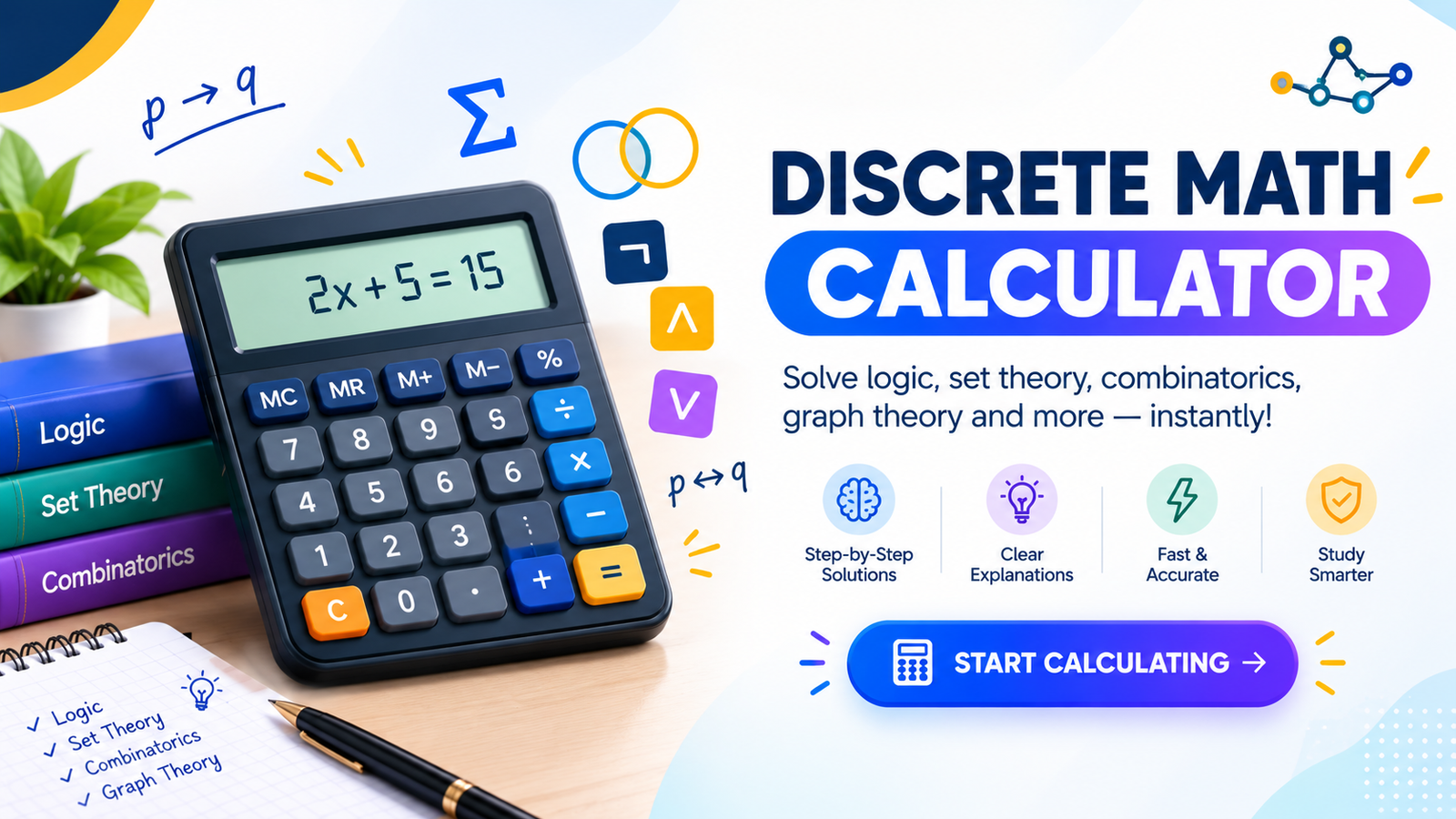
Discrete Math Calculator
Discrete math can become challenging when a problem involves logic, Boolean algebra, combinations, permutations, modular arithmetic, or number theory. Calculating everything manually can also take time, especially when an expression contains multiple steps.
A discrete math calculator provides a practical way to work through these problems, check calculations, and understand mathematical results more efficiently.
Whether you are studying computer science, artificial intelligence, mathematics, or programming, a discrete math calculator can be useful for both practice and verification.
What Is a Discrete Math Calculator?
A discrete math calculator is a specialized online tool designed to solve or evaluate problems related to discrete mathematics.
Unlike a basic calculator that mainly handles arithmetic, a discrete math calculator can work with specific mathematical concepts such as:
- Combinations and permutations
- Boolean algebra
- Truth tables
- Logical operators
- Modular arithmetic
- Number properties
- Relations and functions
- Number theory
- Some graph-related problems
The exact features depend on the calculator, but the main purpose is to make discrete mathematics problems easier to calculate and check.
7 Ways a Discrete Math Calculator Can Help
1. Calculate Combinations and Permutations
Combinations and permutations are important topics in discrete mathematics and combinatorics.
A permutation is used when the order of selected objects matters, while a combination is used when the order does not matter.
The permutation formula is:
P(n,r) = n! / (n-r)!
The combination formula is:
C(n,r) = n! / [r!(n-r)!]
For example, if you have 5 different books and want to arrange 3 of them, you can calculate:
P(5,3) = 5! / (5-3)! = 60
A calculator can perform these calculations quickly, particularly when the numbers and factorials become larger.
2. Generate Truth Tables
Truth tables are commonly used in discrete mathematics, computer science, and logic.
They show possible combinations of logical inputs and the resulting truth value of an expression.
Common operators include:
- AND
- OR
- NOT
- XOR
- NAND
- NOR
- Implication
- Equivalence
For example, an expression such as:
A ∧ (B ∨ ¬C)
can require several rows when all possible values of A, B, and C are considered.
A truth table calculator can generate these combinations and evaluate the expression, saving you from creating every row manually.
This is particularly useful for checking homework, assignments, and practice questions.
3. Simplify Boolean Algebra
Boolean algebra is widely used in computer science, programming, and digital logic.
Long Boolean expressions can be difficult to simplify by hand. A Boolean algebra calculator can help apply common Boolean laws and produce a simpler expression.
Important Boolean laws include:
- Identity law
- Null or dominant law
- Complement law
- Idempotent law
- Double negation law
- Absorption law
- Distributive law
- Commutative law
- De Morgan’s laws
For example:
A ∧ B ∨ A ∧ C
can be factored as:
A ∧ (B ∨ C)
Some calculators can also work with forms such as Conjunctive Normal Form (CNF), Disjunctive Normal Form (DNF), and Negation Normal Form (NNF).
4. Solve Modular Arithmetic Problems
Modular arithmetic focuses on remainders after division.
For example:
17 mod 5 = 2
because dividing 17 by 5 leaves a remainder of 2.
Simple modular calculations are easy, but expressions involving several operations can become more time-consuming.
For example:
(7 mod 3) + (10 mod 4)
A calculator can evaluate each part and provide the final result.
Modular arithmetic is important in several areas, including:
- Computer science
- Algorithms
- Number theory
- Cryptography
- Programming
A discrete math calculator can therefore be useful when practicing these concepts.
5. Check Number Properties
Discrete mathematics also deals with different properties of integers.
Depending on the available calculator features, you may be able to check whether a number is:
- Even or odd
- Prime or composite
- Perfect
- Abundant
- Deficient
- Triangular
- Square
- Cube
- Pentagonal
- Palindromic
- Catalan
- Narcissistic
For example, instead of manually checking several properties of a large integer, a specialized calculator may evaluate them quickly.
This makes it easier to explore number theory and verify your calculations.
6. Evaluate Logical Expressions
Logical reasoning is an important part of discrete mathematics.
A logical expression can contain several operators, making it difficult to evaluate manually.
For example, an expression may use:
| Operator | Meaning |
|---|---|
| AND | Both statements must be true |
| OR | At least one statement is true |
| NOT | Reverses a truth value |
| XOR | Exactly one condition is true |
| Implication | Represents an if-then relationship |
| Equivalence | Both statements have the same truth value |
A discrete math calculator can help evaluate these expressions and make logic practice easier.
For students who are new to logical notation, checking an expression with a calculator can also help identify mistakes in manual work.
7. Save Time on Multi-Step Problems
Discrete mathematics often requires several calculations before reaching the final answer.
For example, one problem may involve:
- Finding a remainder
- Applying a formula
- Simplifying an expression
- Checking the final result
Performing every step manually can take time and increase the chance of an arithmetic mistake.
A discrete mathematics calculator can handle the computational part quickly, allowing you to focus more on the mathematical method and reasoning.
The most useful approach is to solve the problem yourself first and then use the calculator to verify the result.
How to Use a Discrete Math Calculator
Using a discrete math calculator is generally straightforward.
Step 1: Identify Your Problem
First, determine what type of problem you need to solve.
For example:
- Truth table → Use a truth table calculator
- Boolean expression → Use a Boolean algebra calculator
- Arrangements → Use a permutations calculator
- Selection problems → Use a combinations calculator
- Remainders → Use a modulus calculator
Choosing the correct type of calculator is important because different problems require different methods.
Step 2: Enter the Required Information
Enter the numbers, variables, or mathematical expression requested by the calculator.
Check your input carefully before calculating. A calculator can only work with the information you provide.
Step 3: Calculate the Result
Select the Calculate button or the equivalent option provided by the tool.
The calculator will process the input and display the result.
Step 4: Check the Result
If the calculator provides steps, review them rather than looking only at the final answer.
This is especially helpful when you are learning a new discrete mathematics topic.
Main Topics Covered by Discrete Mathematics
A discrete math calculator may support different areas of discrete mathematics. The most common ones include the following.
Combinatorics
Combinatorics focuses on counting, arranging, and selecting objects.
Common problems include:
- Permutations
- Combinations
- Arrangements
- Partitions
- Counting problems
These concepts are often used in probability and computer science.
Mathematical Logic
Mathematical logic deals with statements, truth values, and logical relationships.
Common topics include:
- Propositions
- Logical operators
- Truth tables
- Tautologies
- Contradictions
- Logical equivalence
Boolean Algebra
Boolean algebra deals with binary values and logical operations.
It has important applications in:
- Computer science
- Programming
- Digital logic
- Logic circuits
Number Theory
Number theory focuses on integers and their properties.
Important concepts include:
- Prime numbers
- Divisibility
- Modular arithmetic
- Greatest common divisor
- Euclidean algorithm
- Congruences
Graph Theory
Graph theory studies relationships between objects using structures such as vertices and edges.
It is used in areas such as:
- Computer networks
- Algorithms
- Transportation systems
- Social networks
- Computer science
The exact graph-related functions available depend on the calculator.
Discrete Math Calculator vs. Manual Calculation
Both methods can be useful, but they serve different purposes.
| Method | Best Use |
|---|---|
| Manual calculation | Learning concepts and exam practice |
| Calculator | Checking answers and handling repetitive calculations |
| Both together | Learning and verification |
For example, you can create a truth table manually and then use a calculator to check whether your final results are correct.
This approach helps you learn the process while also reducing unnoticed calculation errors.
Why Discrete Mathematics Is Important in Computer Science
Discrete mathematics is closely connected with computer science because many computing concepts involve discrete structures and logical reasoning.
Its concepts appear in areas such as:
- Algorithms
- Data structures
- Programming
- Artificial intelligence
- Cryptography
- Databases
- Computer networks
- Digital logic
For example, graph theory can be used to represent networks, while Boolean logic is important for computational and digital systems. Combinatorics is useful for counting problems, and number theory has applications in cryptography.
Learning these concepts can therefore provide a strong mathematical foundation for students entering computing-related fields.
Common Mistakes When Using a Discrete Math Calculator
A calculator can help with calculations, but incorrect input can still produce an incorrect result.
Using the Wrong Formula
Make sure you understand whether a problem requires a combination or permutation.
Choosing the Wrong Operator
In logical expressions, changing AND to OR or using the wrong operator can completely change the result.
Forgetting Parentheses
Parentheses can change the order in which an expression is evaluated.
Entering Incorrect Values
Always check numbers, variables, and expressions before calculating.
Copying the Result Without Understanding It
A calculator can provide an answer, but understanding the underlying method is more important for learning and exams.
Is a Discrete Math Calculator Useful for Students?
Yes. A discrete math calculator can be particularly useful when learning unfamiliar topics or checking lengthy calculations.
Students can use it to:
- Check homework
- Verify manual calculations
- Practice different problem types
- Explore logical expressions
- Understand mathematical results
- Reduce repetitive calculations
However, it should support learning rather than replace it.
A good study method is to attempt the problem manually, compare your answer with the calculator, and review any difference between the two results.
Frequently Asked Questions
What is a discrete math calculator?
A discrete math calculator is a specialized tool for solving or evaluating problems related to discrete mathematics, such as logic, Boolean algebra, combinations, permutations, modular arithmetic, and number properties.
What can I calculate with a discrete math calculator?
Depending on the tool, you may be able to calculate combinations, permutations, truth tables, Boolean expressions, modular arithmetic, logical operations, and various number properties.
Can a discrete math calculator create truth tables?
Yes. A dedicated truth table calculator can generate truth tables for logical expressions using operators such as AND, OR, NOT, XOR, implication, and equivalence.
Can I simplify Boolean expressions with a discrete math calculator?
Yes. A Boolean algebra calculator can simplify Boolean expressions using common Boolean laws. Some tools can also generate CNF, DNF, and NNF forms.
Is a discrete math calculator useful for beginners?
Yes. Beginners can use it to check their work and better understand mathematical operations. It is most effective when combined with manual practice and explanations.
Should I use a calculator for discrete math exams?
That depends on your exam rules. If calculators are permitted, it can help with calculations, but you should still understand the concepts and methods required by the course.
Is a discrete math calculator free?
Many online discrete math calculators are available without payment, although features and usage limits can differ between tools.
Final Thoughts
Discrete mathematics becomes much easier to manage when you have the right approach and tools.
A discrete math calculator can help with important areas such as truth tables, Boolean algebra, combinations, permutations, modular arithmetic, logic, and number properties. It can also save time on repetitive calculations and help you identify mistakes in your work.
The best way to use one is not simply to enter a problem and copy the answer. Try the problem first, use the calculator to verify your work, and understand why the result is correct.
That turns a discrete math calculator from a simple answer generator into a practical tool for learning, practicing, and improving your mathematical problem-solving skills.