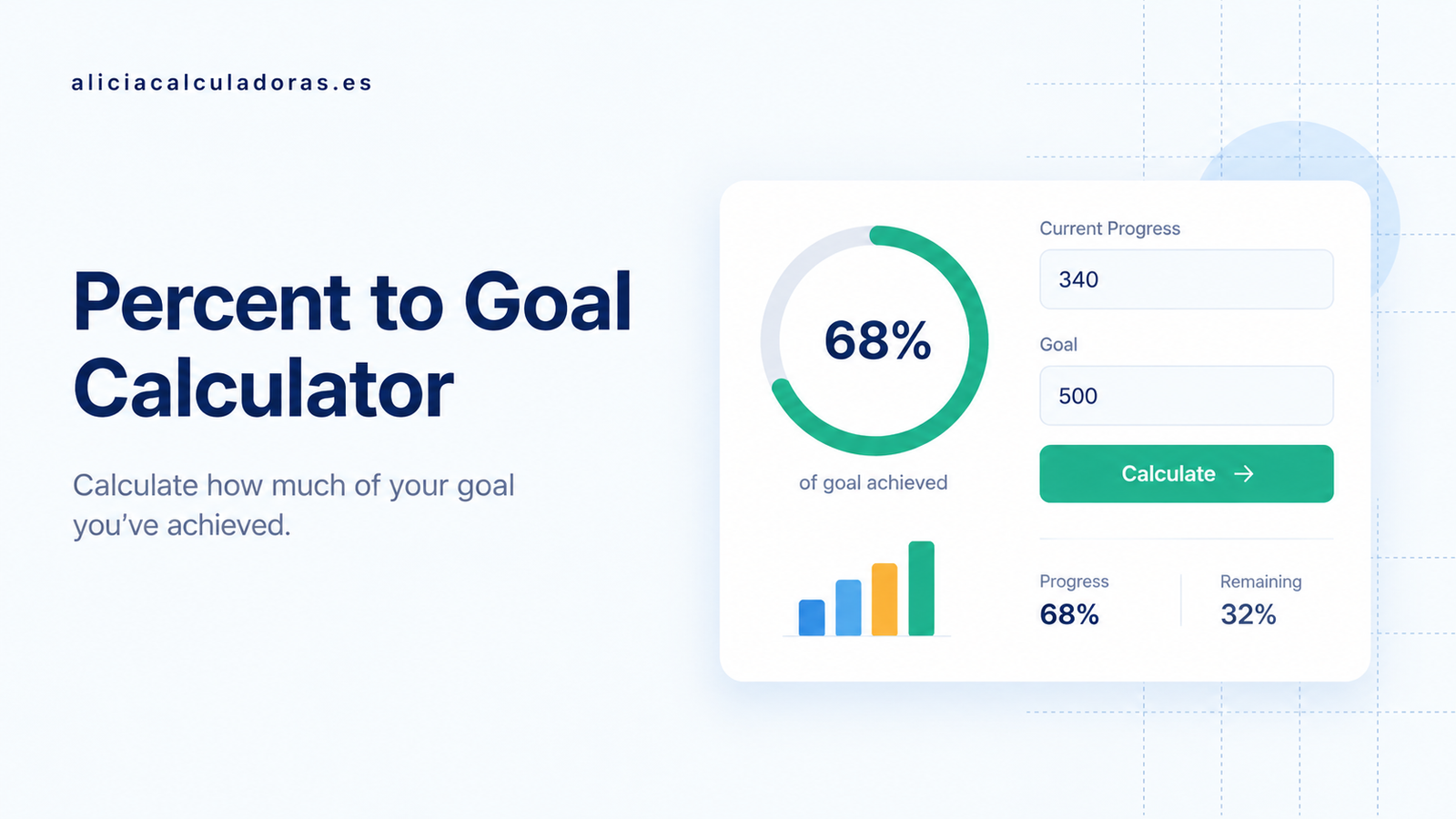
Percent to Goal Calculator
Reaching a goal is easier when you know how much progress you have made. A percent to goal calculation shows the portion of a target you have achieved, expressed as a percentage.
For example, if your current progress is 390 and your goal is 500:
You have completed 78% of your goal, so 22% remains.
Percent-to-goal calculations can be used for sales targets, savings, fundraising, completed tasks, study plans, project milestones, and many other measurable goals.
In this guide, you’ll learn what percent to goal means, how to calculate it manually, how to interpret the result, how to calculate the percentage remaining, and how to avoid common calculation mistakes.
What Is a Percent to Goal Calculator?
A Percent to Goal Calculator determines how much of a target you have achieved compared with the total goal.
It uses two main values:
- Current Progress: The amount you have achieved so far.
- Goal: The total target you want to reach.
For example:
- Current progress: 75
- Goal: 100
- Percent to goal: 75%
This means you have completed 75% of the target.
A percent-to-goal calculation can be used with different measurements, including:
- Money
- Sales
- Tasks
- Units
- Distance
- Pages
- Lessons
- Project milestones
The current value and goal should represent the same type of measurement.
Percent to Goal Calculator Formula
The standard percent to goal formula is:
Where:
- Current Progress is the amount achieved so far.
- Goal is the total target.
- Percent to Goal is the percentage of the target achieved.
Example
Suppose you have completed 390 tasks and your goal is 500 tasks.
Your progress is 78% of the goal.
How to Calculate Percent to Goal Calculator
You can calculate the percentage of a goal in three simple steps.
Step 1: Identify Your Current Progress
Determine how much you have achieved so far.
Current progress = 390
Step 2: Identify Your Goal
Determine the total target you want to reach.
Goal = 500
Step 3: Apply the Formula
Divide your current progress by the goal and multiply by 100:
Therefore, your percent to goal is 78%.
How to Use a Percent to Goal Calculator
A percent-to-goal calculation requires two values:
- Current Value: The amount you have achieved.
- Goal Value: The total target you want to reach.
The calculation divides the current value by the goal and multiplies the result by 100.
For example:
Current Value: 390
Goal Value: 500
Result: 78%
The two values should use the same measurement. For example, if the goal is measured in kilometers, the current progress should also be measured in kilometers.
Percent to Goal Calculator Examples
Example 1: 390 Out of 500
If your current progress is 390 and your goal is 500:
Answer: 78%
You have completed 78% of the goal.
The remaining amount is:
So, 110 units remain.
Example 2: 15 Out of 26
If you have achieved 15 toward a goal of 26:
Answer: 57.69%
You have completed approximately 57.69% of your goal.
Example 3: 20 Out of 400
If your progress is 20 and your goal is 400:
Answer: 5%
Your current progress represents 5% of the total goal.
Example 4: 440 Out of 1,000
If you have achieved 440 toward a goal of 1,000:
Answer: 44%
You have reached 44% of your target.
Example 5: Saving $5,000 Toward $20,000
Suppose your savings target is $20,000 and you have saved $5,000:
Answer: 25%
You have reached 25% of your savings goal.
Example 6: Project Tasks
A project has 200 planned tasks, and 140 have been completed:
Answer: 70%
Based on the number of completed tasks, the project is 70% of the way to its target.
What Does Your Percent to Goal Mean?
The result shows how much of the original target has been achieved.
| Percent to Goal | Meaning |
|---|---|
| 0% | No progress has been achieved |
| 25% | One-quarter of the goal is complete |
| 50% | Half of the goal is complete |
| 75% | Three-quarters of the goal is complete |
| 90% | You are close to the goal |
| 100% | The goal has been reached |
| More than 100% | The original goal has been exceeded |
For example, 80% to goal means the current progress is equal to 80% of the target.
Can Percent to Goal Be More Than 100%?
Yes. A percent to goal can be greater than 100% when your current progress exceeds your target.
For example:
- Current progress: 150
- Goal: 100
Answer: 150%
This means your current result is 1.5 times the original goal.
A result above 100% simply indicates that the target has been exceeded.
How to Calculate Percentage Remaining
If you know your percent to goal, you can calculate the percentage remaining by subtracting it from 100%.
The formula is:
For example, if you have reached 78% of your goal:
So, 22% of the goal remains.
You can also calculate the remaining amount directly:
For a goal of 500 and progress of 390:
Therefore, 110 units remain.
Percent to Goal vs. Percentage Increase
Percent to goal and percentage increase are different calculations.
Percent to Goal
Percent to goal measures current progress compared with a target:
For example, if your progress is $8,000 toward a $10,000 goal:
You are 80% of the way to your goal.
Percentage Increase
Percentage increase measures how much a value has changed from an original value:
For example, if sales increase from $10,000 to $12,000:
The sales increased by 20%.
So, 80% to goal does not mean an 80% increase. The two calculations measure different things.
Real-World Uses of Percent to Goal Calculations
A percentage of goal is useful whenever progress can be expressed numerically.
Sales Targets
A sales representative has a monthly target of $100,000 and has generated $78,000:
The sales target is 78% achieved.
Savings Goals
You want to save $10,000 and have already saved $3,500:
You have reached 35% of your savings goal.
Fundraising
A fundraising campaign has a target of $50,000 and has collected $12,500:
The campaign has reached 25% of its fundraising target.
Study Goals
Suppose you plan to complete 40 lessons and have finished 30:
You have completed 75% of your study goal.
Project Completion
A project has 80 planned tasks and 60 are complete:
The project has completed 75% of its planned tasks based on task count.
Why Is Percent to Goal Useful?
A raw number does not always show how much progress has been made.
For example, completing 40 tasks can represent different levels of progress depending on the target.
If the goal is 50 tasks:
But if the goal is 200 tasks:
The current progress is the same—40 tasks—but the percentage of the goal is different.
Expressing progress as a percentage therefore provides useful context and makes it easier to understand how a current value compares with a target.
Common Percent to Goal Mistakes
1. Reversing the Values
The current progress should be divided by the goal.
Correct:
If you reverse the values:
you get a different result.
2. Forgetting to Multiply by 100
Dividing 390 by 500 gives:
This is the decimal representation. To express it as a percentage:
3. Using Different Units
The current value and goal should use the same unit.
For example, don’t compare 5 kilometers of progress with a goal measured in 10 miles without first converting the units.
4. Assuming 100% Is the Maximum
A percent to goal can exceed 100% when current progress is greater than the target.
For example, 125% means the current value is 1.25 times the goal.
5. Rounding Too Early
If a calculation produces several decimal places, complete the calculation first and round the final result.
For example:
The result can be rounded to 57.69%.
How to Calculate the Progress Needed for a Specific Percentage
Sometimes you know the percentage you want to reach and the total goal, but need to find the corresponding progress value.
Rearrange the percent-to-goal formula:
Example
Suppose your goal is 800 and you want to know what value represents 60% of the goal:
So, 480 represents 60% of an 800 goal.
This calculation can be useful when determining measurable milestones.
What If the Goal Is Zero?
The standard percent-to-goal formula divides the current progress by the goal:
If the goal is zero, the calculation requires division by zero, which is mathematically undefined.
Therefore, for a standard percent-to-goal calculation, the goal should be greater than zero.
Frequently Asked Questions
How do I calculate percent to goal?
Divide your current progress by your goal and multiply by 100.
What is 390 out of 500 as a percentage?
390 out of 500 is:
So, the answer is 78%.
What is 15 out of 26 as a percentage?
15 out of 26 is approximately 57.69%.
What is 20 out of 400 as a percentage?
20 out of 400 is 5%.
What is 440 out of 1,000 as a percentage?
440 out of 1,000 is 44%.
Can percent to goal be over 100%?
Yes. If current progress is greater than the goal, the result will be above 100%. For example, 150 toward a goal of 100 equals 150%.
How do I calculate the percentage remaining?
Subtract your percent to goal from 100%.
For example:
If you are 78% toward your goal, 22% remains.
Is percent to goal the same as percentage increase?
No. Percent to goal measures progress toward a target, while percentage increase measures the change between an original value and a new value.
Can I use percent to goal for money?
Yes. You can use the calculation for savings, sales, fundraising, or other financial targets as long as the current value and goal represent the same type of amount and currency.
What if my current progress equals my goal?
If your current progress equals your goal, your percent to goal is 100%, meaning the target has been reached.
Final Takeaway
The Percent to Goal Calculator provides a simple way to measure how much of a target has been achieved.
The formula is:
For example, 390 toward a goal of 500 equals 78%.
The Percent to Goal Calculator can be used for sales targets, savings, fundraising, projects, study goals, completed tasks, and many other measurable objectives.
Understanding the percentage of a goal also makes it easier to determine how much remains, compare progress with different targets, and identify when a target has been reached or exceeded.