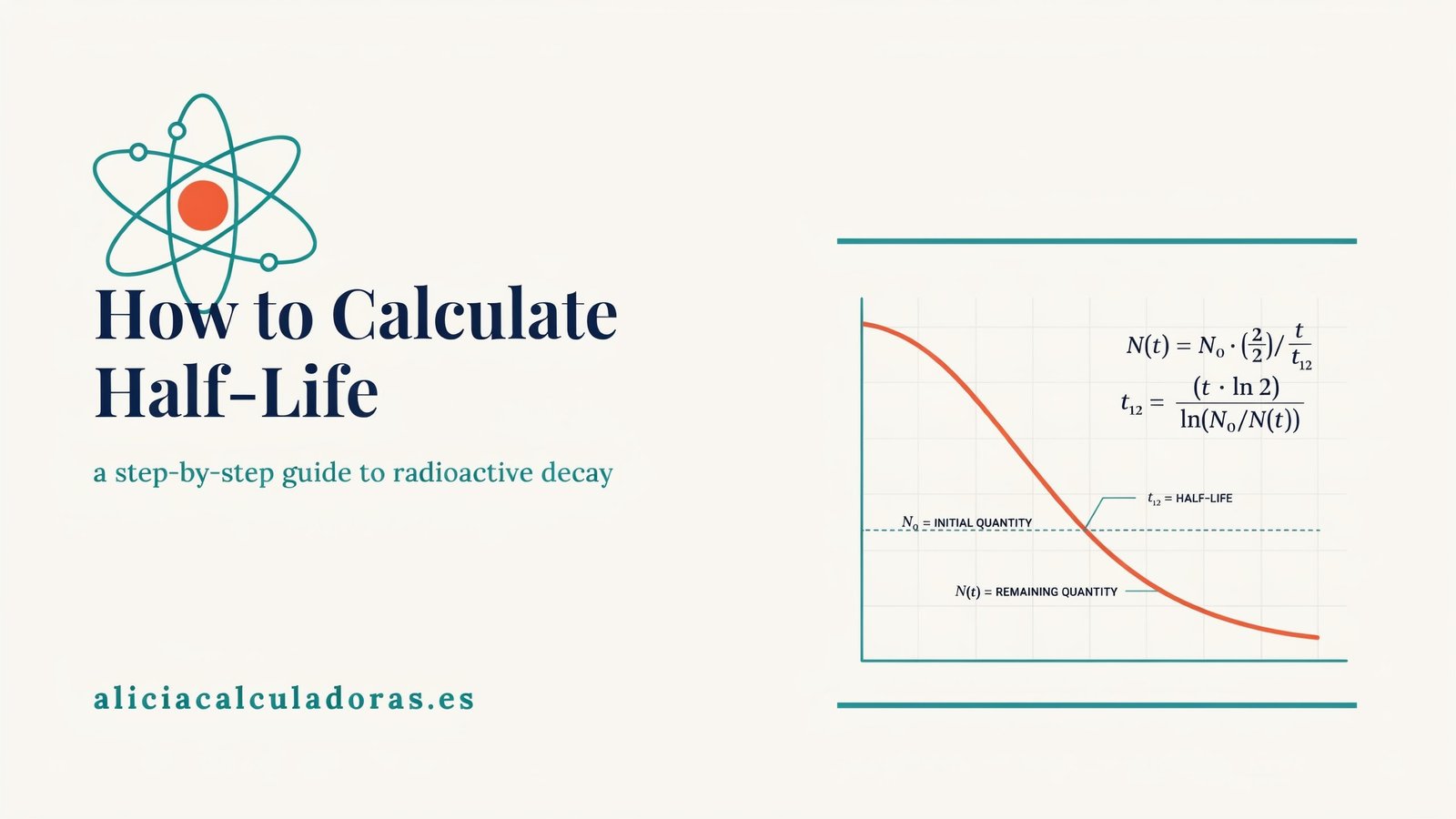
How to Calculate Half-Life
Half-life is the time required for a quantity to decrease to half of its original amount. It is used in radioactive decay, chemistry, physics, pharmacology, and exponential decay problems.
You can calculate half-life from the decay constant, initial amount, remaining amount, elapsed time, or percentage remaining. The formula depends on the information given.
What Is Half-Life?
Half-life describes how quickly a quantity decreases during an exponential decay process.
For example, if a substance starts at 100 g and its half-life is 5 hours, the amount becomes 50 g after 5 hours, 25 g after 10 hours, and 12.5 g after 15 hours.
| Half-Lives | Amount Remaining |
|---|---|
| 0 | 100 g |
| 1 | 50 g |
| 2 | 25 g |
| 3 | 12.5 g |
| 4 | 6.25 g |
After each half-life, half of the current amount remains.
Half-Life Formula
The main half-life equation is:
N = N₀(1/2)^(t/t₁/₂)
Where:
- N₀ = initial amount
- N = remaining amount
- t = elapsed time
- t₁/₂ = half-life
This formula is useful for exponential decay calculations and radioactive decay problems.
How to Calculate Half-Life
The best method depends on what values you know. Here are the most common ways to find How to Calculate Half-Life.
1. Calculate Half-Life From the Decay Constant
If the decay constant (λ) is known, use:
t₁/₂ = ln(2) / λ
Because ln(2) ≈ 0.693, you can also use:
t₁/₂ = 0.693 / λ
Example
Suppose:
λ = 0.05 per hour
Then:
t₁/₂ = 0.693 / 0.05
t₁/₂ = 13.86 hours
So the half-life is approximately 13.86 hours.
2. Calculate Half-Life From Initial and Remaining Amount
If you know the initial amount, remaining amount, and elapsed time, use:
t₁/₂ = t × ln(2) / ln(N₀/N)
Example
A sample decreases from 100 g to 25 g in 10 hours.
Given:
- N₀ = 100 g
- N = 25 g
- t = 10 hours
Substitute the values:
t₁/₂ = 10 × ln(2) / ln(100/25)
The result is:
t₁/₂ = 5 hours
Therefore, the half-life is 5 hours.
3. Calculate Half-Life by Counting Halvings
For simple half-life problems, you may not need logarithms.
Suppose the amount changes like this:
80 → 40 → 20 → 10
The amount was reduced by half three times.
If this happened in 18 hours:
Half-life = 18 ÷ 3
Half-life = 6 hours
This is the quickest method when the values form exact halves.
How to Calculate the Amount Remaining
If the How to Calculate Half-Life is known and you need to find the remaining amount, use:
N = N₀(1/2)^(t/t₁/₂)
Example
A substance starts with 200 g and has a half-life of 4 hours. How much remains after 12 hours?
Number of half-lives:
12 ÷ 4 = 3
Now:
N = 200(1/2)³
N = 200 × 1/8
N = 25 g
So, 25 g remains after 12 hours.
How to Calculate Time Using Half-Life
Sometimes the half-life and amounts are known, but the elapsed time is unknown.
Use:
t = t₁/₂ × ln(N₀/N) / ln(2)
Example
A substance has a half-life of 6 hours and decreases from 80 g to 20 g.
The amounts change:
80 → 40 → 20
That is 2 half-lives.
Therefore:
t = 2 × 6 = 12 hours
The elapsed time is 12 hours.
How to Calculate Half-Life From Percentage
Percentage questions become easier when you first find the percentage remaining.
For example, if 75% has decayed:
100% − 75% = 25% remaining
Convert 25% to a decimal:
25% = 0.25
Because:
0.25 = (1/2)²
two half-lives have passed.
If each half-life is 8 years:
Time = 2 × 8 = 16 years
Percentage Remaining After Each Half-Life
| Half-Lives | Percentage Remaining |
|---|---|
| 1 | 50% |
| 2 | 25% |
| 3 | 12.5% |
| 4 | 6.25% |
| 5 | 3.125% |
This pattern is useful for solving simple radioactive decay and exponential decay questions.
Half-Life and Decay Constant
The decay constant represents the rate of exponential decay.
The relationship between half-life and decay constant is:
t₁/₂ = 0.693 / λ
You can also find the decay constant from half-life:
λ = 0.693 / t₁/₂
A shorter half-life means a larger decay constant, while a longer half-life means a smaller decay constant.
Half-Life and Exponential Decay
Half-life is directly related to exponential decay.
The exponential decay equation is:
N = N₀e^(-λt)
The half-life form is:
N = N₀(1/2)^(t/t₁/₂)
Both equations describe the same exponential decay process.
Half-Life in Radioactive Decay
In radioactive decay, unstable atomic nuclei transform over time.
The radioactive How to Calculate Half-Life is the time needed for half of the radioactive nuclei in a sample to decay.
For a specific radioactive isotope, its half-life is a characteristic property and does not depend on the initial amount.
Half-Life in First-Order Reactions
Half-life is also important in first-order chemical reactions.
For a first-order reaction:
t₁/₂ = 0.693 / k
Here, k is the reaction rate constant.
For a first-order reaction, the half-life does not depend on the initial concentration.
How to Calculate Half-Life From a Graph
A half-life graph can be used to estimate the half-life visually.
Find the initial amount on the vertical axis, then locate half of that amount and read the corresponding time on the horizontal axis.
For example, if a graph starts at 100 units and reaches 50 units at 8 minutes, the half-life is 8 minutes.
Half-Life Calculation: Which Formula Should You Use?
| What You Know | Formula |
|---|---|
| Decay constant | t₁/₂ = 0.693/λ |
| Initial amount, remaining amount, and time | t₁/₂ = t ln(2)/ln(N₀/N) |
| Half-life, initial amount, and time | N = N₀(1/2)^(t/t₁/₂) |
| Half-life and amounts | t = t₁/₂ ln(N₀/N)/ln(2) |
| Exact number of halvings | Half-life = total time ÷ number of halvings |
Choose the formula that matches the information provided in the question.
How to Calculate Half-Life Step by Step
For most problems, follow these steps:
Step 1: Identify the Known Values
Write down the initial amount, remaining amount, elapsed time, half-life, or decay constant.
Step 2: Identify the Unknown
Determine whether you need to find the half-life, remaining amount, decay constant, or time.
Step 3: Choose the Formula
Select the equation that contains the values you already know.
Step 4: Keep Units Consistent
Use the same time unit throughout the calculation.
For example, a decay constant in hours⁻¹ gives a half-life in hours.
Step 5: Substitute the Values
Enter the known values carefully and use parentheses where necessary.
Step 6: Calculate
Solve the equation and keep extra decimal places during intermediate calculations.
Step 7: Check the Result
Make sure the answer has the correct unit and is reasonable for the given values.
Half-Life Example: Complete Problem
A radioactive sample has an initial mass of 160 g. After 15 hours, only 20 g remains. Find the half-life.
Step 1: Find the Remaining Fraction
20 ÷ 160 = 0.125
Step 2: Convert the Fraction
0.125 = 1/8
And:
1/8 = (1/2)³
Therefore, 3 half-lives have passed.
Step 3: Calculate the Half-Life
15 ÷ 3 = 5 hours
Answer
Half-life = 5 hours
Common Half-Life Mistakes
Confusing Decayed Amount With Remaining Amount
If 70% has decayed, then:
100% − 70% = 30% remaining
Use 30% as the remaining amount.
Mixing Time Units
Do not combine hours and minutes without converting them.
Keep all time values in the same unit.
Confusing Half-Life With Decay Constant
Half-life and decay constant are related but different quantities.
Remember:
t₁/₂ = 0.693/λ
Forgetting Parentheses
Logarithmic formulas can produce incorrect results if entered incorrectly.
Use parentheses when entering expressions into a calculator.
Rounding Too Early
Keep enough decimal places during intermediate calculations.
Round the final answer at the end unless your problem gives different instructions.
Using a Half-Life Calculator
A half-life calculator can quickly evaluate decay problems when the required values are known.
Depending on the tool, you may enter the initial amount, remaining amount, elapsed time, half-life, or decay constant to find the missing value.
It is useful for checking calculations, but understanding the half-life formula helps you know why the result is correct.
When Is a Half-Life Calculator Useful?
A half-life calculator can be useful when:
- You need to check a manual calculation.
- The numbers are difficult to calculate by hand.
- You are working with logarithms.
- You want to compare different decay scenarios.
- You need to find remaining quantity after several half-lives.
For learning, solve the problem first when possible, then use the calculator to verify the result.
Frequently Asked Questions
What is the easiest way to How to Calculate Half-Life?
If the amount decreases by exact halves, count the halvings and divide the total time by that number.
For non-exact values, use the half-life equation and logarithms.
What is the basic half-life formula?
The main equation is:
N = N₀(1/2)^(t/t₁/₂)
When the decay constant is known:
t₁/₂ = 0.693/λ
How do you calculate half-life from a decay constant?
Use:
t₁/₂ = 0.693/λ
Insert the decay constant and keep the time units consistent.
How do you calculate half-life from initial and remaining amounts?
If elapsed time is also known, use:
t₁/₂ = t × ln(2) / ln(N₀/N)
How do you calculate half-life from a percentage?
First find the percentage remaining.
If 75% has decayed, 25% remains. Convert the percentage to a decimal and use the half-life equation.
Does half-life depend on the initial amount?
For radioactive decay and first-order reactions, half-life is independent of the initial amount or concentration.
What units can half-life have?
Half-life can be expressed in seconds, minutes, hours, days, years, or another appropriate unit of time.
Final Takeaway
To calculate half-life, first identify what information the problem provides.
Use t₁/₂ = 0.693/λ when the decay constant is known. If the initial amount, remaining amount, and elapsed time are given, use t₁/₂ = t ln(2)/ln(N₀/N).
For simple problems with exact halvings, counting the number of half-lives is often the fastest approach. These methods can help you solve radioactive decay, exponential decay, and first-order reaction problems accurately.